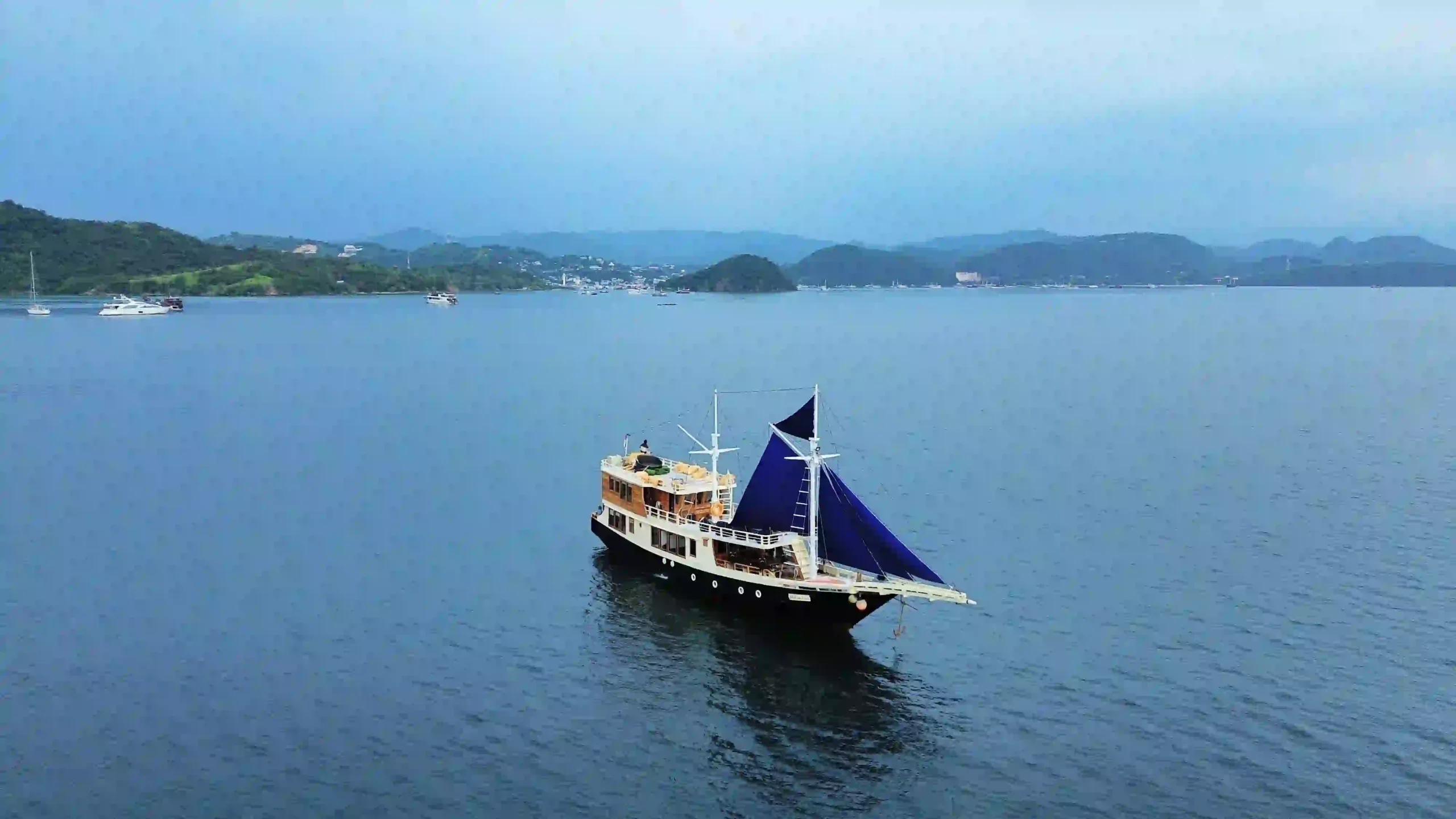
What the hull is really made of, how the deck plan works, and what the published 2027 fleet actually costs.
| Part of the Boat | Timber Used | Why That Timber | What You Notice |
|---|---|---|---|
| Keel & main structure | Ulin / ironwood | Extremely dense, resists rot and marine borers | The boat sits low and heavy; roll is slow, not snappy |
| Hull planking | Bitti and teak | Strong, workable, tolerant of constant immersion | Hull noise is a low creak under way, not a slam |
| Deck & superstructure | Teak / jati | Rot resistance plus a walkable wet surface | Bare feet on deck at midday are bearable |
| Cabin joinery & interior | Teak and local hardwoods | Stable, finishes well, low resin smell | Cabins smell of wood and oil, not resin |
| Masts & spars | Hardwood or laminated timber (some alloy) | Weight aloft is deliberately limited | Two masts, gaff-style rig, set on open crossings |
The engine room sits aft, so cabins closest to the stern are the noisiest and cheapest. Cabins forward of midships on the same deck are quiet but move more in swell.
Dining saloon, galley and the largest cabins. On most boats the master or signature cabin sits here, often with a window or small private balcony rather than a porthole.
Sun beds, shaded lounge, sometimes one premium cabin. This is where the boat is actually lived in between stops — its size matters more than the brochure suggests.
| Phinisi | Length | Cabins | Max Guests | Whole Boat / Night |
|---|---|---|---|---|
| Jinggo Janggo | 22 m | 2 | 5 | from USD 1,800 |
| Anne Bonny | 30 m | 3 | 9 | from USD 3,800 |
| Manta Mae | 30.35 m | 5 | 12 | from USD 4,200 |
| Sands Bajo | 23 m | 6 | 12 | from USD 4,450 |
| Samara 1 Cruise | 27 m | 5 | 12 | from USD 4,600 |
| Jakare | 35 m | 5 | 10 | from USD 4,900 |
| Majik Cruise | 42 m | 4 | 8 | from USD 5,700 + 11% VAT |
| Nala | 37 m | 5 | 10 | from USD 6,500 |
| Kayra Phinisi Yacht | 38 m | 4 | 8 | from USD 7,000 |
| Neptune Cruise Phinisi | 40 m | 7 | 20 | from USD 8,900 |
| Lasha Phinisi Cruise | 52.5 m | 10 | 26 | from USD 10,800 |
| Celestia | 45 m | 7 | 14 | from USD 13,500 + 11% tax |
| Vela | 50 m | 6 | 12 | from USD 17,000 + 12% VAT |
| Silolona | 50 m | 5 | 10 | from USD 18,700 + 12% VAT |
| Lamima | 65.2 m | 7 | 14 | from USD 27,000 + 11% VAT |
It means the hull is real timber rather than fibreglass or steel: an ironwood keel, bitti or teak planking, teak decks, built by hand in South Sulawesi. The craft is UNESCO-listed as Pinisi, art of boatbuilding in South Sulawesi (2017).
Published whole-boat rates run from USD 1,800 per night for a 22 m boutique phinisi up to USD 27,000 per night plus 11% VAT for the 65.2 m Lamima. Most family-sized boats sit between USD 4,200 and USD 8,900 per night.
Between two and fourteen. The common charter sizes are five to nine cabins carrying ten to twenty-five guests; only the largest vessels go beyond that.
The published fleet spans 22 m to 65.2 m. A 30 to 40 m hull is the sweet spot for Komodo — enough deck for twelve to twenty guests, shallow enough draft for the inshore bays.
Both bases exist and are not interchangeable. Whole-boat charter is quoted per night for the entire vessel. Shared cabins are quoted per person, from USD 300 to USD 800 depending on cabin class.
Yes, but they are used selectively. Crews set sail on open crossings when wind and schedule allow, and run under engine for timed arrivals such as the pre-dawn approach to Padar.
No. Under PP 36/2024 the park entrance fee is IDR 250,000 per foreign visitor per visit, collected separately from the charter rate.
Not inherently — condition and crew matter far more than hull material. Ask when the boat was last slipped, who surveys it, and how many crew hold current certificates.
Tell us your dates, group size and whether you want the whole boat or a single cabin — our team will come back with the vessels genuinely free on those nights.
Chat on WhatsApp